
Front Range seeding crew
Hydroseeding in Denver, CO
New lawns, dryland natives and stabilized slopes, prepared for clay soil, high sun and summer cloudbursts.
- No-charge site visits, with every estimate in writing
- Seed mixes picked for your elevation, sun and water
- Estimates that list prep, seed, mulch and slope work separately
Seed That Has to Work at 5,280 Feet
Hydroseeding in Denver is a different job than it is in a wet eastern city. Denver sits in the South Platte River valley on the western edge of the High Plains, just east of the Front Range, at an official elevation of 5,280 feet. The climate is cool semi-arid, with generally low humidity, about 3,100 hours of sunshine a year and roughly 14.5 inches of precipitation in an average year. Seed sprayed on bare ground here has to survive strong sun, drying wind, big swings between day and night temperatures and the occasional storm that drops an inch of rain in an afternoon. We spray new lawns, dryland native grass, slopes and construction sites across the metro, and we prepare the ground first so the seed has a fair chance.
What hydroseeding is
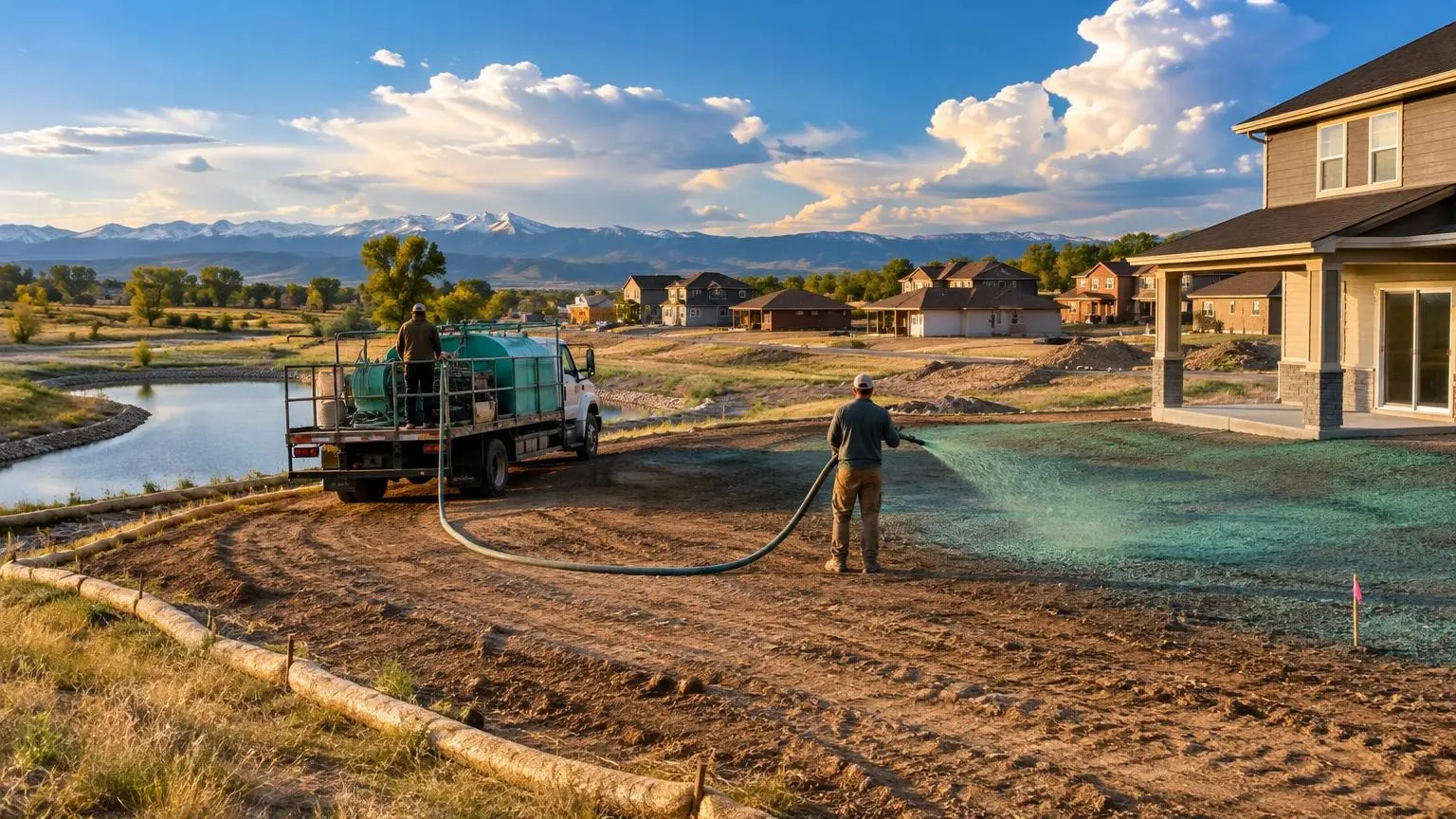
Hydro seeding blends water with grass seed, fertilizer, a tackifier and a wood or paper fiber mulch inside a tank, and the slurry is then sprayed onto prepared soil. The colored mulch shows where coverage is complete, holds moisture against the seed and glues it in place on slopes. Under good conditions the first sprouts show in about one to two weeks, and Colorado State University Extension notes that germination can take up to two weeks, during which the soil surface has to stay moist. That moisture is the hard part in Denver, and it is why we talk about irrigation before we talk about price.
The soil under Front Range lawns
Much of the plains east of the mountains is covered by loamy grassland soils. The USDA's Ascalon series, a plains soil of large extent in eastern Colorado, is a good example: a grayish-brown fine sandy loam on top, a sandy clay loam subsoil with 18 to 35 percent clay, and lime (calcium carbonate) starting 8 to 30 inches down, where the soil turns moderately alkaline. Native cover on soils like it is mostly blue grama. Many lots across the metro also sit on swelling clay. The Colorado Geological Survey calls expansive soil the state's most significant geologic hazard and lists poor surface drainage and irrigation water soaking in beside foundations among the landscaping mistakes that make it worse. That is why grading comes before seeding on most of our jobs: the finished grade has to carry water away from the house, and new construction lots often need topsoil or compost worked in before any seed goes down.
Sod, hydroseed or dry seed
Sod gives an instant lawn, and Colorado growers produce good bluegrass sod, but it costs the most. HomeGuide puts hydroseeding at $0.12 to $0.35 for each square foot of lawn, while laying sod runs $1 to $4 a square foot by the same guide. Broadcast dry seed is the cheapest, but on Denver's windy, sunny lots bare seed dries out, blows around and gets eaten, and on any slope it washes off in the first thunderstorm. Hydroseed sits in between: it costs a little more than dry seeding and much less than sod, the mulch protects the seed while it sprouts, and it lets us use the exact seed mix your site needs, including native grasses you will rarely find as sod. For a large yard, a slope or a lot that needs a specific dryland mix, it is usually the better value.
When to seed in Denver
The typical Denver lawn is built from cool-season species, chiefly Kentucky bluegrass, with perennial ryegrass and turf-type tall fescue mixed in. CSU Extension says cool-season grasses are easier to establish in late summer and recommends sowing a Kentucky bluegrass blend in late August to early September, when the hottest days are past and the seedlings get a full fall to root in. Spring seeding works too, but May through August brings both most of the year's rain and July highs near 90 degrees, so spring seedings need steady watering. Warm-season natives such as buffalograss and blue grama are different: CSU says buffalograss is usually seeded in May or June, and it is limited to elevations of about 6,500 feet or less. Measurable snow normally falls from mid-October to late April, so late fall work is mostly limited to temporary stabilization on job sites.
Thunderstorms, hail and bare dirt
Denver gets most of its precipitation from April through August, and much of it arrives as afternoon thunderstorms. Denver also ranks among the most hail-prone large cities in the continental US. Bare, freshly graded soil is at its most vulnerable during exactly those months. On a home lot that means a washed-out seedbed and mud on the sidewalk. On a construction site it can mean sediment in the gutter and a problem with the inspector. The City and County of Denver may require a Construction Activities Stormwater Discharge Permit for work that disturbs an acre or more, is part of a larger development plan, or has significant potential for erosion. Hydromulch, erosion control blankets, silt fence and inlet protection are how we keep that soil in place until grass takes over.
What we do
Our hydroseeding services cover the whole job, not just the spray: new lawn installation for homes, commercial and development seeding for builders, erosion control on slopes, swales and channels, silt fence and sediment control for permitted sites, yard grading and topsoil, and native grass seeding for dryland areas and low-water yards. When a drainage fix calls for digging, the same dirt-work crew does the excavation and cuts the trench. Describe the yard or lot as it sits today and the result you are after, and we will take it from there.
What the first six weeks look like
We leave written watering instructions on the day we spray. In general that means light, frequent watering to keep the mulch and the soil surface damp until the grass is up, then fewer, deeper waterings as the roots grow. According to HomeGuide, a new hydroseeded lawn typically reaches mowing height after four to six weeks. Keep foot traffic, pets and vehicles off it until then, and expect to see a few thin spots that fill in or get a touch-up later. A lawn seeded in late summer usually needs less babysitting than one seeded in June, because the days are shorter and the nights cooler.
Why Homeowners Call Elite Hydroseeding Denver
Grade before seed
We check that finished grade drains away from the house before we spray, because on Front Range clay that matters more than the seed.
Mixes matched to the site
Bluegrass or tall fescue for irrigated lawns, buffalograss and blue grama for dryland ground, erosion mixes for slopes and job sites.
Seasonal timing
We plan cool-season lawns for late summer when we can and warm-season natives for late spring, and we tell you the tradeoffs of other dates.
Line-item estimates
Grading, topsoil, seed, mulch, blankets and silt fence are listed one by one, so no cost is buried in a lump sum.
Neighborhoods and Suburbs We Seed
We work in Denver itself and across the surrounding counties. North of the city, Brighton sits below 5,000 feet near the South Platte, Commerce City borders the Rocky Mountain Arsenal refuge, and Thornton and Northglenn began as planned communities in the 1950s, with newer subdivisions around them. To the west, Arvada, Wheat Ridge, Lakewood and Golden run up toward the foothills, with creek corridors like Clear Creek and Bear Creek and more slope to manage. The south metro, from Englewood and Littleton to Centennial, Highlands Ranch, Lone Tree, Ken Caryl, Parker, Castle Pines and Castle Rock, climbs higher and cuts through more gulches and ravines, and Castle Pines sits above the elevation where buffalograss is a good fit. Aurora spreads east across hundreds of subdivisions, and in the northwest, Broomfield, Erie, Superior and Louisville include coal-mining history and neighborhoods hit by the 2021 Marshall Fire. Pick your town below for its own soil, slope and stormwater notes.
- Hydroseeding in Denver, CO
- Hydroseeding in Aurora, CO
- Hydroseeding in Lakewood, CO
- Hydroseeding in Arvada, CO
- Hydroseeding in Westminster, CO
- Hydroseeding in Thornton, CO
- Hydroseeding in Centennial, CO
- Hydroseeding in Highlands Ranch, CO
- Hydroseeding in Castle Rock, CO
- Hydroseeding in Parker, CO
- Hydroseeding in Littleton, CO
- Hydroseeding in Broomfield, CO
- Hydroseeding in Commerce City, CO
- Hydroseeding in Brighton, CO
- Hydroseeding in Northglenn, CO
- Hydroseeding in Golden, CO
- Hydroseeding in Wheat Ridge, CO
- Hydroseeding in Englewood, CO
- Hydroseeding in Lone Tree, CO
- Hydroseeding in Castle Pines, CO
- Hydroseeding in Erie, CO
- Hydroseeding in Superior, CO
- Hydroseeding in Louisville, CO
- Hydroseeding in Ken Caryl, CO
Our Services
From a single backyard to a graded subdivision, these are the six jobs our Front Range crews take on.
Home Lawn Hydroseeding
New lawns sprayed with bluegrass, tall fescue or low-water blends on properly graded, amended soil.
Learn more →Commercial & Development Hydroseeding
Seeding for builders, developers and site managers: lots, common areas, detention ponds and final stabilization.
Learn more →Erosion Control Blankets & Hydromulch
Slope stabilization with straw and coir blankets, heavy hydromulch and bonded fiber matrix on banks, swales and channels.
Learn more →Silt Fence & Construction BMPs
Silt fence, inlet protection, wattles and other sediment control for permitted construction sites.
Learn more →Yard Grading & Soil Amendment
Dirt work before seed: yard grading away from foundations, topsoil, compost and drainage fixes.
Learn more →Native Grass & Dryland Seeding
Buffalograss, blue grama and native mixes for low-water lawns, open space, acreage and wildflower areas.
Learn more →
Common Questions
How much does a hydroseed job cost in Denver?
Published national guides vary by source, putting residential hydroseeding somewhere between $0.06 and $0.35 per square foot. For a lawn of 5,000 square feet, HomeGuide lists about $1,000 to $1,750, and most companies have a minimum job fee of $300 to $500. Grading, topsoil, slopes and native seed mixes add to that, so we set each Denver price once we have walked the property.
Is hydroseeding worth the money?
For most yards larger than a few thousand square feet, yes. It costs far less than sod, protects the seed better than dry broadcasting, and lets us spray the exact mix your sun, water and elevation call for. Sod still makes sense for a small area you need finished right away.
Is lawn hydroseeding expensive compared with sod?
No. By HomeGuide's numbers, laying sod costs $1 to $4 a square foot and hydroseeding $0.12 to $0.35, and Bob Vila's guide says hydroseeding typically runs 50 to 80 percent less than sod. The tradeoff is time: a hydroseeded lawn needs several weeks of careful watering before it is ready to use.
Which part of the Denver year gives hydroseed its best start?
For Kentucky bluegrass and other cool-season lawns, late August to early September is ideal, according to CSU Extension. Spring works with steady watering. Buffalograss and blue grama are warm-season natives and are usually seeded in May or June.
Will hydroseed grow without irrigation in Colorado?
An irrigated bluegrass or fescue lawn needs regular water to establish and to stay green. Native mixes like buffalograss and blue grama are built for dryland conditions, but they still need moisture to germinate, so timing the seeding to rain or giving temporary water makes a big difference.
Can you hydroseed on expansive clay soil?
Yes, but the soil prep matters. We loosen the surface, work in compost or topsoil where needed, and make sure the grade drains away from the foundation, since the Colorado Geological Survey warns that irrigation water soaking in near a house is one of the ways swelling clay causes damage.
Do I need a stormwater permit to seed my lot?
A normal homeowner lawn usually does not. Denver may require a Construction Activities Stormwater Discharge Permit for work that disturbs an acre or more, is part of a larger development plan, or has significant erosion potential. If you have one, we install and maintain the controls it calls for.
Book a Free Denver Site Visit
Tell us about the ground, and we will walk it with you and send a written estimate.